
GEX Upside/Downside: Reading Market Structure Like a Pro
Question: Why does Bitcoin sometimes feel like it's swimming through concrete on the upside, while other times it rockets through resistance like paper?
Answer: Look at the GEX Upside/Downside ratio. It's showing you where the hedging "weight" sits.
Most traders know about gamma exposure (GEX) and flip points. But there's a deeper layer: how much hedging pressure exists above vs below current price. This asymmetry reveals where market makers' hedging flows will concentrate as price moves.
TL;DR: The GEX Upside/Downside ratio tells you where hedging activity is concentrated relative to price. Master these three numbers — Upside GEX, Downside GEX, and Ratio — and you'll trade structure, not hope.
Real-World Example: Reading the Structure
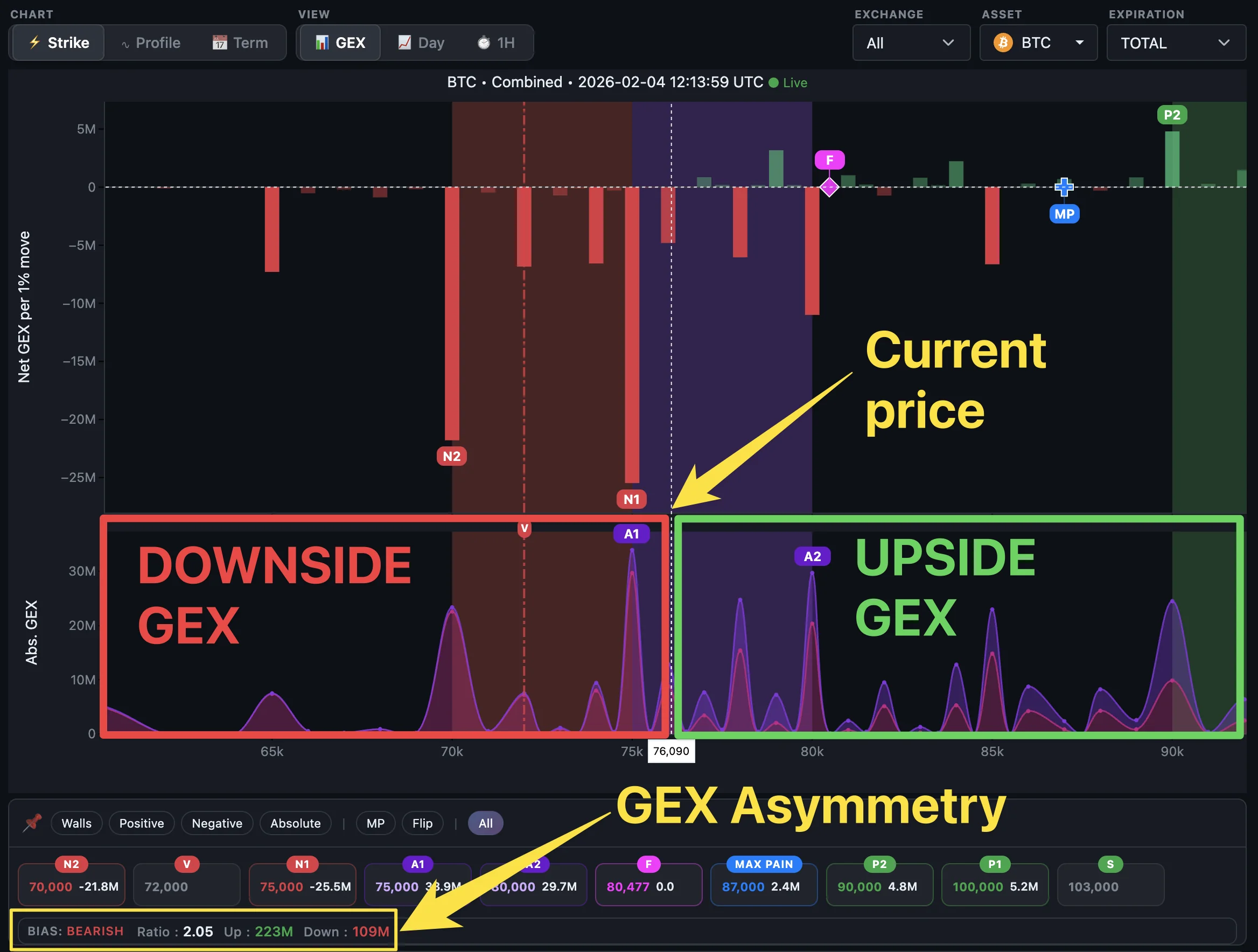 Example: BTC facing high Upside GEX — ratio +0.34 signals heavy hedging pressure above
Heavy Upside Pressure (Ratio > +0.1) -- The Concrete Ceiling
Setup:
What This Means: - Massive hedging obligations above ($80,000+ range) - Light hedging obligations below (less structural activity) - Most hedging flows activate on upward moves - Dealers must hedge more aggressively as price rises than as it falls
Risk Management: If price breaks resistance with strong volume, respect the move — structure can break. Hedging flows create friction, not absolute barriers.
The Three Core Metrics
When you view the GEX by Strike rotating panel, you'll see these numbers. In the example above:
- Upside GEX: 222M
- Downside GEX: 109M
- Ratio: +0.34
Let's decode exactly what these mean.
1. Upside GEX -- Hedging Pressure Above
This is the sum of all absolute GEX from strikes above the current price.
Think of it as the total "hedging pressure" market makers must handle if price moves up. Higher Upside GEX means more hedging activity as price rises.
High Upside GEX (e.g., 200M+): - Heavy options positioning above current price - Dealers must actively hedge as price approaches these strikes - Creates structural friction on upward moves - Large hedging flows activate on rallies
Example: BTC at $60K with 250M Upside GEX means massive hedging obligations at higher strikes. As price climbs toward those levels, dealers must adjust their hedges, creating structural friction on the upside.
2. Downside GEX -- Hedging Pressure Below
This is the sum of all absolute GEX from strikes at or below current price.
This represents the hedging pressure waiting below. Higher Downside GEX means more dealer activity if price falls.
High Downside GEX (e.g., 150M+): - Heavy options positioning below current price - Dealers actively hedge on downward moves - Large hedging flows activate on dips - Can create structural friction on sell-offs
Example: BTC at $58K with 180M Downside GEX at lower strikes suggests substantial hedging obligations below. As price falls toward those levels, dealer hedging activity intensifies.
3. GEX Upside/Downside Ratio -- The Balance of Pressure
This is where it gets actionable:
Ratio = (Upside GEX - Downside GEX) / (Upside GEX + Downside GEX)
The result ranges from -1 to +1, making it easy to read and comparable across different assets and expirations.
Both values use absolute GEX (already calculated in GEX by Strike). We're measuring the structural balance of positioning above vs below — pure hedging volume, regardless of option type.
Interpretation:
| Ratio | Meaning | Bar Direction |
|---|---|---|
| > +0.1 | More hedging pressure above price | Bar points UP |
| -0.1 to +0.1 | Balanced hedging activity | Near zero |
| < -0.1 | More hedging pressure below price | Bar points DOWN |
The bar direction matches the spatial meaning — bars pointing up mean more pressure above, bars pointing down mean more pressure below. Color intensity shows magnitude.
In our example, the Ratio of +0.34 tells you there's significantly more hedging pressure above than below.
Important: This metric shows where hedging activity concentrates — not whether price will go up or down. Use it alongside GEX Put/Call for directional context. P/C tells you what kind of gamma dominates (calls vs puts), U/D tells you where it sits.
How Is This Calculated?
- Start with GEX by Strike data: Each strike already has its
total_gexvalue (absolute sum of call + put GEX) - Current price split: Divide strikes into two groups based on current market price
- Sum each side:
- Upside GEX = Sum of
total_gexfor all strikes above current price - Downside GEX = Sum of
total_gexfor all strikes at/below current price - Normalize: (Upside - Downside) / (Upside + Downside) -> GEX Upside/Downside Ratio
Why normalize? The raw Upside/Downside values depend on the asset and market conditions. The normalized -1 to +1 scale makes the ratio instantly readable and comparable across assets (BTC vs ETH vs SOL) and across expirations in the term chart.
Key point: The ratio is a snapshot measurement using current market data. We're asking: "Right now, at current price, how is the total hedging pressure distributed above vs below?"
Important distinction: We measure total hedging obligations (absolute GEX) for all strikes above/below current price. We don't differentiate between calls and puts — we simply know where the heaviest hedging activity will concentrate as price moves. A high Upside GEX could come from out-of-the-money calls, in-the-money puts, or a mix of both. What matters is the total pressure, not the option type.
The Open Interest Analogy (But Better)
You know open interest — it shows where contracts are clustered. But OI is passive. It's like counting how many spectators are at a game.
GEX Upside/Downside is active. It measures how much force those spectators exert when they all lean in one direction.
| Metric | What It Shows | What It Misses |
|---|---|---|
| Open Interest | Where contracts exist | How much hedging pressure they create |
| GEX Upside/Downside | Where hedging flows will concentrate | Individual trade details |
Visual analogy:
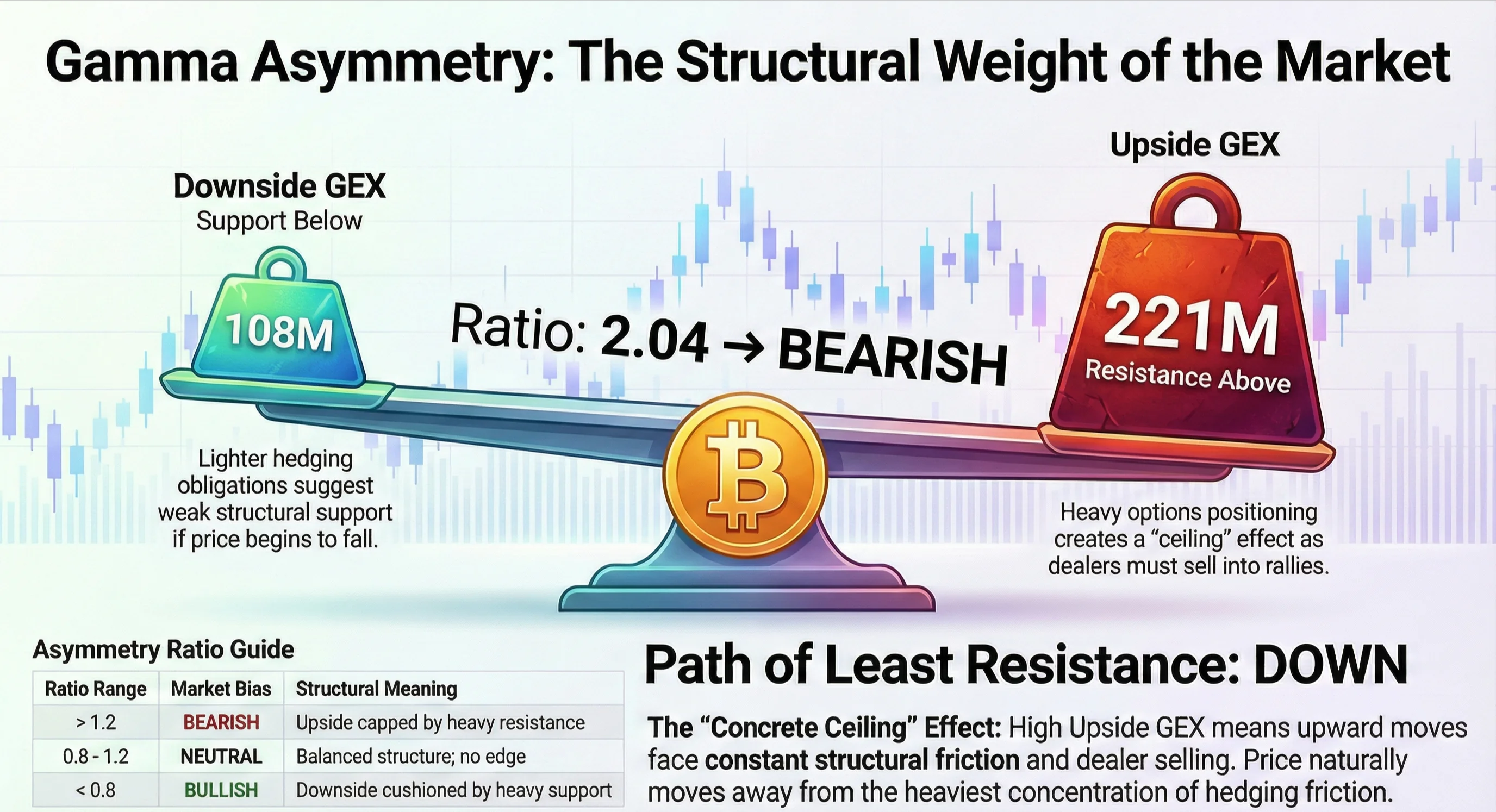
Imagine Bitcoin price as a ball balanced on a scale: - High Upside GEX = Heavy weight above (hedging flows concentrate on rallies) - High Downside GEX = Heavy weight below (hedging flows concentrate on dips) - Ratio near +1 = Almost all hedging pressure sits above price
When Upside GEX (222M) is double Downside GEX (109M), the hedging machine is loaded above — dealers are far more active when price moves up than when it moves down.
Key Takeaways
- Upside/Downside GEX quantifies hedging pressure above and below current price
- Ratio > +0.1 = more hedging pressure above price (bar points up)
- Ratio < -0.1 = more hedging pressure below price (bar points down)
- Unlike open interest, GEX measures active hedging obligations, not passive positioning
- This is a structural metric, not a directional signal — use with GEX P/C for direction
- Now grouped with GEX by Strike for intuitive snapshot analysis
- Normalized -1 to +1 scale matches the GEX Upside/Downside term chart for consistency
- Best used in combination with technical levels, volume profile, and catalyst timing
The Bottom Line
Open Interest tells you where traders are positioned. GEX Upside/Downside tells you where the hedging machine is loaded.
Next time you see Bitcoin pinned below a level despite bullish news, check the Upside GEX. Chances are, you're staring at 200M+ of hedging pressure — market makers' flows creating structural friction above.
The smart trade isn't fighting it. It's understanding where the hedging weight sits and positioning accordingly.
Why GEX Upside/Downside Is on the "GEX by Strike" Tab
The GEX Upside/Downside panel lives on the GEX by Strike tab because it makes conceptual sense:
- GEX by Strike = Snapshot of current market state
- Shows where strikes are positioned RIGHT NOW
- GEX Put/Call = snapshot metric (current call/put balance)
- GEX Upside/Downside = snapshot metric (current pressure balance)
-
Both metrics answer: "What is the market structure at this moment?"
-
Gamma Profile = Forecast tool
- Models how gamma will change if price moves to different levels
- Shows future regime transitions
- Answers: "How will behavior change as price moves?"
This reorganization groups snapshot metrics together (GEX Put/Call + GEX Upside/Downside), separating them from forecast tools (Gamma Profile + dynamic modeling). The result: clearer mental models and faster decision-making.
You'll find GEX Upside/Downside in the rotating panel on GEX by Strike, cycling with GEX Put/Call. The ratio uses color intensity to show magnitude — stronger readings are more vivid.
Want to see this in action? Open the GEX by Strike view and watch the rotating panel. You'll start seeing the market's invisible structure — and that changes everything.
Disclaimer: This article is for educational purposes only. Gamma asymmetry analysis involves assumptions about market maker positioning and is not a guarantee of future price movement. Always manage risk appropriately and combine multiple analysis methods. Options trading carries significant risk.
Ready to see GEX in action?
Try GammaFlip.io and experience professional-grade gamma exposure analysis
Open Dashboard